` Choosing the Right Particle Counter: Key Factors to Consider
Quick Links - Alpha Controls & Instrumentation Inc.

Social media
Contact information
Address

2900 John St.
Unit 4
Markham, ON  L3R 5G3 - Canada

Email

Phone

(905) 477-2133

Fax

(905) 477-4219

Blog

Choosing the Right Particle Counter: Key Factors to Consider

Posted: 5/30/2024
Share: print this article   Email A Friend   Share with LinkedIn   Share with Facebook   Share with Twitter  
Selecting the right particle counter for your application can be daunting, given the plethora of options available to you. From cleanroom monitoring to industrial environments, particle counters are essential tools for ensuring air quality and compliance with industry standards. 
 
Here’s a comprehensive guide to help you navigate the selection process and find the perfect particle counter for your needs:

 
1. Understand Your Application Requirements
Environment: Start by identifying where the particle counter will be used. Are you monitoring a cleanroom, an industrial setting, or outdoor air quality? Each environment has unique requirements that will influence your choice.
Type of Particles: Determine the types and sizes of particles you need to measure. Are you dealing with dust, smoke, or microorganisms? Understanding your specific needs will help narrow down your options.
 
2. Measurement Range and Sensitivity
Particle Size Range: Ensure the counter can detect the particle sizes relevant to your application. Typical ranges include 0.1 to 10 micrometers, but your specific needs may vary.
Sensitivity: Higher sensitivity is crucial for detecting smaller particles. Check the lower limit of detection to ensure it meets your requirements.
 
3. Flow Rate
Sample Flow Rate: This refers to the volume of air sampled per unit of time, usually measured in cubic feet per minute (CFM). Two common flow rates are 0.1 to 1 CFM but can be as high as 100 liters per minute.  Make sure the flow rate is appropriate for your sampling needs to ensure accurate measurements.
 
4. Data Logging and Analysis
Data Storage: Look for counters with adequate data storage capacity and various options for data transfer, such as USB, Ethernet, or Wi-Fi. This ensures you can easily retrieve and manage your data.
Software: Ensure the particle counter comes with compatible and user-friendly software for data analysis and reporting. Good software can simplify the process of interpreting your data and generating reports.
 
5. Portability and Ease of Use
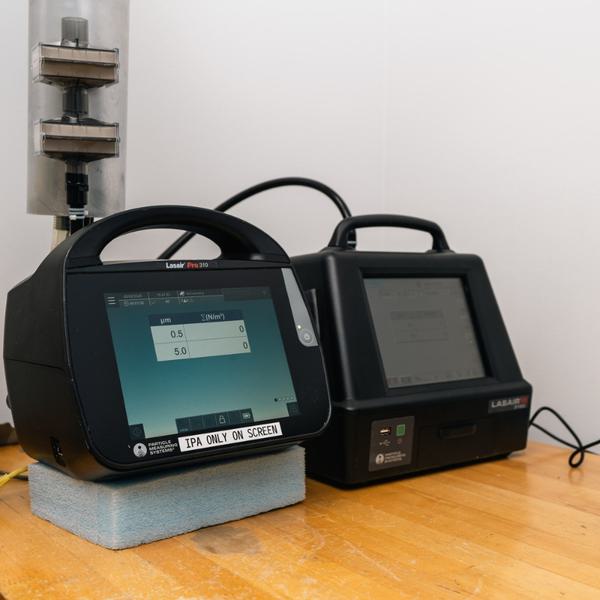
Portability: Depending on your needs, you might prefer a handheld, portable unit or a stationary, benchtop model. Portability can be crucial for fieldwork or when you need to move the device between locations.
Ease of Use: Look for user-friendly interfaces, intuitive controls, and easy maintenance. A device that is simple to operate will save you time and reduce the likelihood of errors.
 
6. Compliance and Standards
Regulatory Standards: Ensure the particle counter complies with relevant industry standards and regulations. Compliance ensures your device meets established benchmarks for performance and accuracy.
 
7. Calibration and Maintenance
Calibration: Check if the device requires regular calibration and how easily this can be done. Some models offer automated calibration features, which can save time and ensure consistent accuracy.
Maintenance: Consider the maintenance requirements, availability of support, and replacement parts. A device that is easy to maintain will have a longer lifespan and lower total cost of ownership.
 
8. Environmental Conditions
Operating Conditions: Ensure the counter can operate under your specific environmental conditions, such as temperature, humidity, and pressure ranges. This is particularly important if you’re working in extreme environments.
 
9. Cost
Budget: Evaluate the cost of the particle counter in relation to your budget. Remember to consider the total cost of ownership, including maintenance and calibration, rather than just the upfront purchase price.
 
10. Brand and Support
Reputation: Choose a reputable brand known for quality and reliability. A well-established brand is more likely to provide a dependable product. For example: Particle Measuring Systems sets the standard for cleanroom contamination monitoring and precision is the heart of what they do. 
 
By carefully considering these factors, you can select a particle counter that effectively meets your application needs and provides accurate and reliable data. Investing time in choosing the right device will ensure you get the best performance and value for your specific requirements. Whether you’re monitoring air quality in a cleanroom or assessing environmental pollution, the right particle counter is a crucial tool for achieving your goals.
If you have any questions or want to speak to an expert to help guide you – call us at 1-800-567-8686 or email us at alphasales@alphacontrols.com . We’d be happy to help in any way we can!