
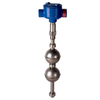
A float switch is comprised of a permanent magnet to ensure it moves along with the liquid level on a guide tube and provides accurate level readings. The guide tube is fitted with a reed contact (inert gas contact) and is energized by the approach of the float magnet. By using a magnet and reed contact, the operation of the float switch is non-contact, free from wear and needs no power supply. The contacts are potential-free. Magnetic float switches are also available with multiple switch points.
The switch functions always refer to a rising liquid level: SPDT or change-over contact.
Using a float for two switch points creates a bi-stable switch operation, meaning that the switching status remains available when the filling level continues to rise above or drop below the switch point.
A float switch is simple to mount and maintenance-free, providing a cost-effective solution.


• Large range of applications due to the simple, proven functional principle
• For harsh operating conditions, long service life
• Operating limits:
- Operating temperature: T = -196 to +350 °C
- Operating pressure: P = Vacuum to 40 bar
- Limit density: ρ ≥ 300 kg/m³
• Wide variety of different electrical connections, process connections and materials
• FM approved version / NEMA 4x or 7/9 housing
• Process connection, guide tube and float from 316L/316Ti stainless steel or plastic
• Universal signal processing: connection direct to a PLC is possible, NAMUR connection, signal amplification / contact protection relays
• Works independently of foaming, conductivity, dielectricity, pressure, vacuum, temperature, steam, condensation, bubble formation, boiling effects and vibrations.
• Level measurement for almost all liquid media
• Pump/level control and monitoring for defined filling levels
• Chemical industry, petrochemical industry, natural gas, offshore, shipbuilding, machine building, power generating equipment, power stations
• Process water and drinking water treatment, food and beverage industry